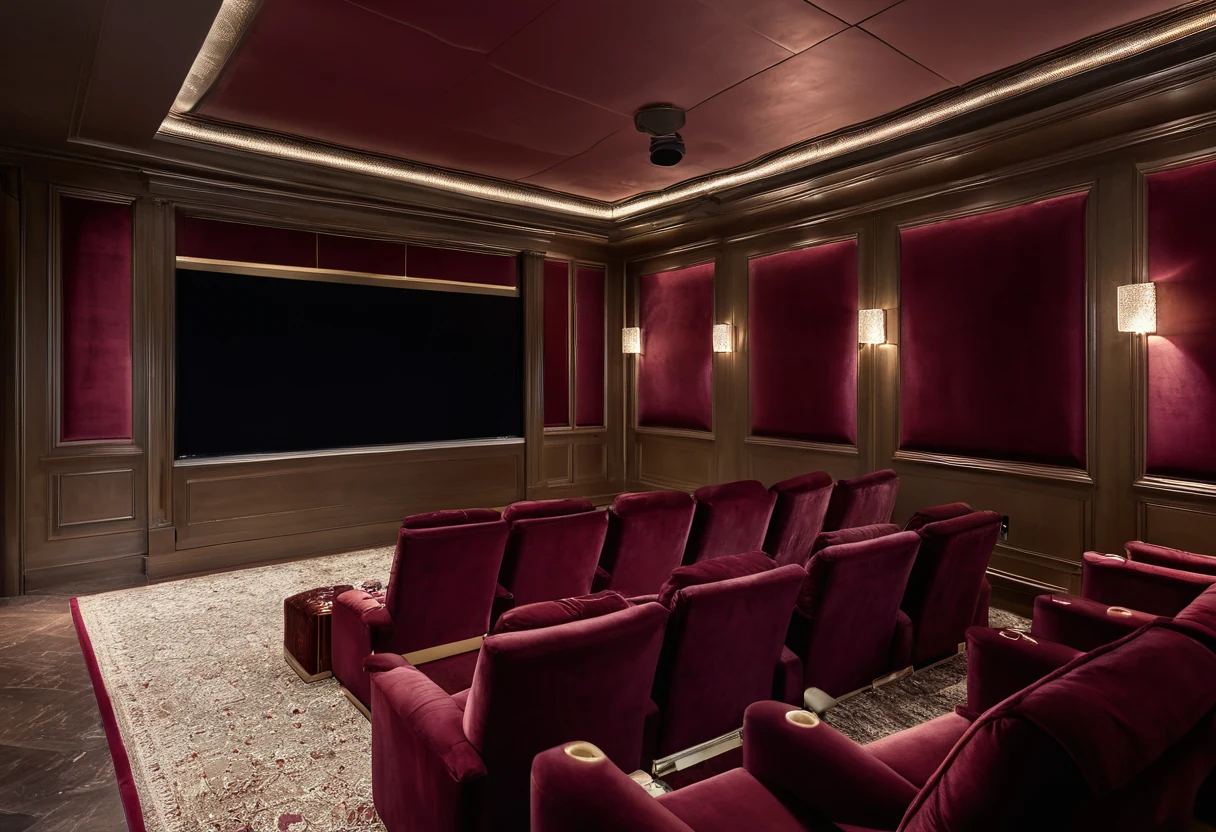
Every surface in a private cinema is an acoustic component wearing decoration: velvet drapes are broadband absorbers, carved wood panels are diffusers, the corner columns are bass traps, and the difference between a room that sounds expensive and a room that sounds like a marble bathroom is physics specified to the millimeter. This article follows one sound wave from the speaker cone to the listener’s ear, layer by layer, and ends with six acoustic devices that pass as pure decor. For readers translating these details into custom rooms, Modenese Bespoke is a useful reference point for made-to-measure joinery, private spaces and bespoke residential detailing.
Millisecond Zero: The Wave Leaves the Speaker at 343 Meters per Second
Sound travels at 343 meters per second in room air, so in a 7-meter cinema the direct wave reaches the main seats in about 12 milliseconds, and everything the room will do to the soundtrack happens in the tenths of a second after that. The design target is brutal by living-room standards: home cinema practice aims at a reverberation time (RT60) of roughly 0.3 to 0.5 seconds, against 0.8 to 1.2 in a typical furnished lounge and 2 or more in a hard-surfaced hall. Short reverberation is what makes dialogue intelligible at low volume and effects precise at high volume, and short reverberation is bought with surface area: square meters of absorption and diffusion that someone has to make beautiful.
Milliseconds 2 to 20: First Reflections, Where Walls Smear the Dialogue
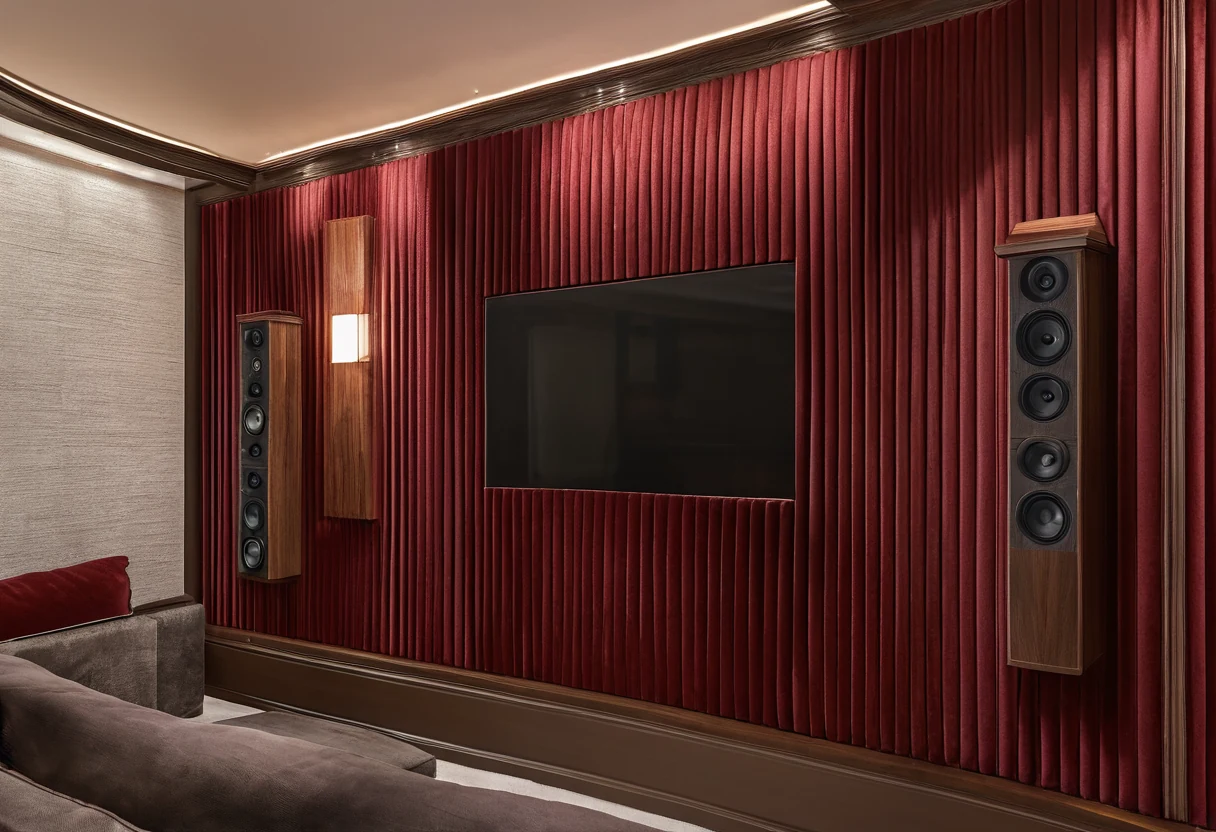
The wave’s first bounce off the side walls and ceiling arrives at the ear within 2 to 20 milliseconds of the direct sound, inside the window where hearing fuses both into one event (the precedence effect). Fused is not harmless: strong early reflections blur stereo imaging and thicken dialogue, which is why designers treat the mirror points, the wall zones where a seated viewer would see the speakers reflected, with absorption first. The decorative translation is the upholstered wall panel: 50 to 100 millimeters of mineral wool or acoustic foam behind stretched fabric, a device with a noise reduction coefficient near 0.8 to 1.0, indistinguishable from paneled upholstery once a workshop wraps it in velvet and frames it in walnut.
Reader experiment 1: stand in your own living room and clap once, hard. The brief metallic “zing” after the clap is flutter echo between parallel hard walls, and a cinema wall treatment exists to make that sound impossible.
The Low End: Why Corners Get Columns and Sofas Get Subwoofers’ Respect
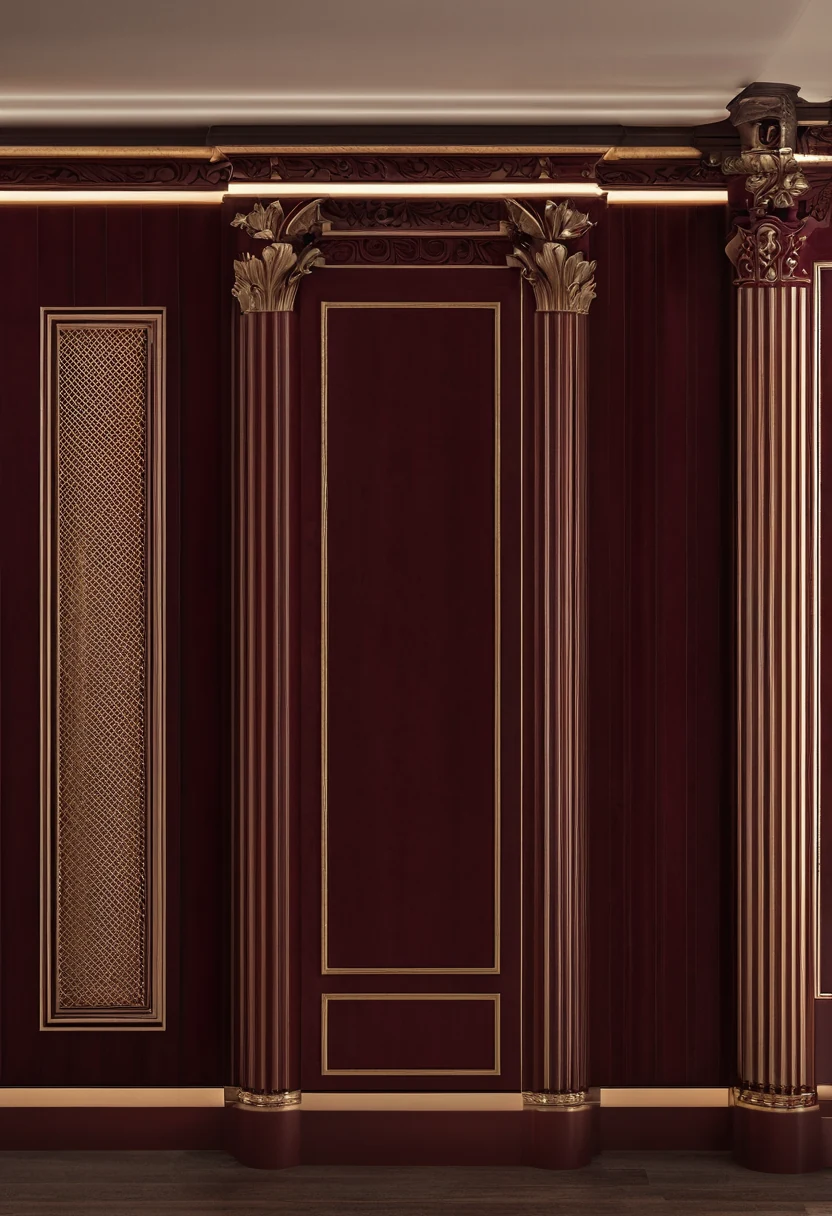
Below about 200 hertz, the room stops scattering sound and starts resonating with it: room modes, standing waves between parallel surfaces, boost some bass notes and cancel others depending on where the listener sits. A 7-meter dimension has its first mode near 24.5 hertz (343 divided by twice the length), squarely in soundtrack territory. Pressure maxima live in corners, which is why serious rooms put their bass absorption exactly there: corner traps of thick porous material or tuned membrane absorbers, frequently disguised as classical columns, pilasters or casework. Perforated wood panels backed by sealed cavities work as Helmholtz resonators, tuned by hole size and cavity depth to swallow specific problem frequencies, engineering that reads, on the wall, as a decorative fretwork screen.
The Surfaces: Velvet, Wood and Perforation Do Three Different Jobs
The article’s title earns its keep here, because materials are frequency-selective and a good room casts them like an orchestra. Heavy velvet or velour drapery, hung with 100 percent fullness (two meters of fabric per meter of wall), absorbs strongly through the mid and high frequencies, with published coefficients around 0.5 to 0.75 above 500 hertz; velvet is the room’s de-esser, taming harshness and flutter. Solid wood paneling absorbs very little but, shaped into ribs, coffers and carved relief, diffuses: scattering reflections so the room sounds alive rather than dead, the role pure absorption can never play alone. Perforated and slotted wood hybridizes the two, absorbing where its cavity tunes it and diffusing above. The craft brief for a bespoke home cinema is exactly this casting: which walls absorb, which diffuse, which resonate, decided in the acoustic model, then drawn as architecture.
Reader experiment 2: speak while walking from a tiled bathroom into a closet full of clothes. The change in your own voice is the velvet principle: soft, deep, porous surfaces removing energy that hard ones return.
The Last Meter: What the Ear Actually Receives
At the seat, the design either converges or collapses. A finished reference-grade room delivers the direct wave, controlled early reflections, smooth bass within a few decibels across the seating rows, background noise held near NC 20 to 25 (the HVAC engineering nobody sees), and a decay of 0.3 to 0.5 seconds that lets a whispered line land. The audience is part of the calculation: upholstered seats are specified partly because rows of them absorb almost identically whether occupied or empty, so the room sounds the same at a family screening and a full house. None of this physics is visible from the doorway, which is the point: the guest sees burgundy velvet, walnut coffers and columns, and hears, for the first time in most lives, a film the way the mixing stage heard it.
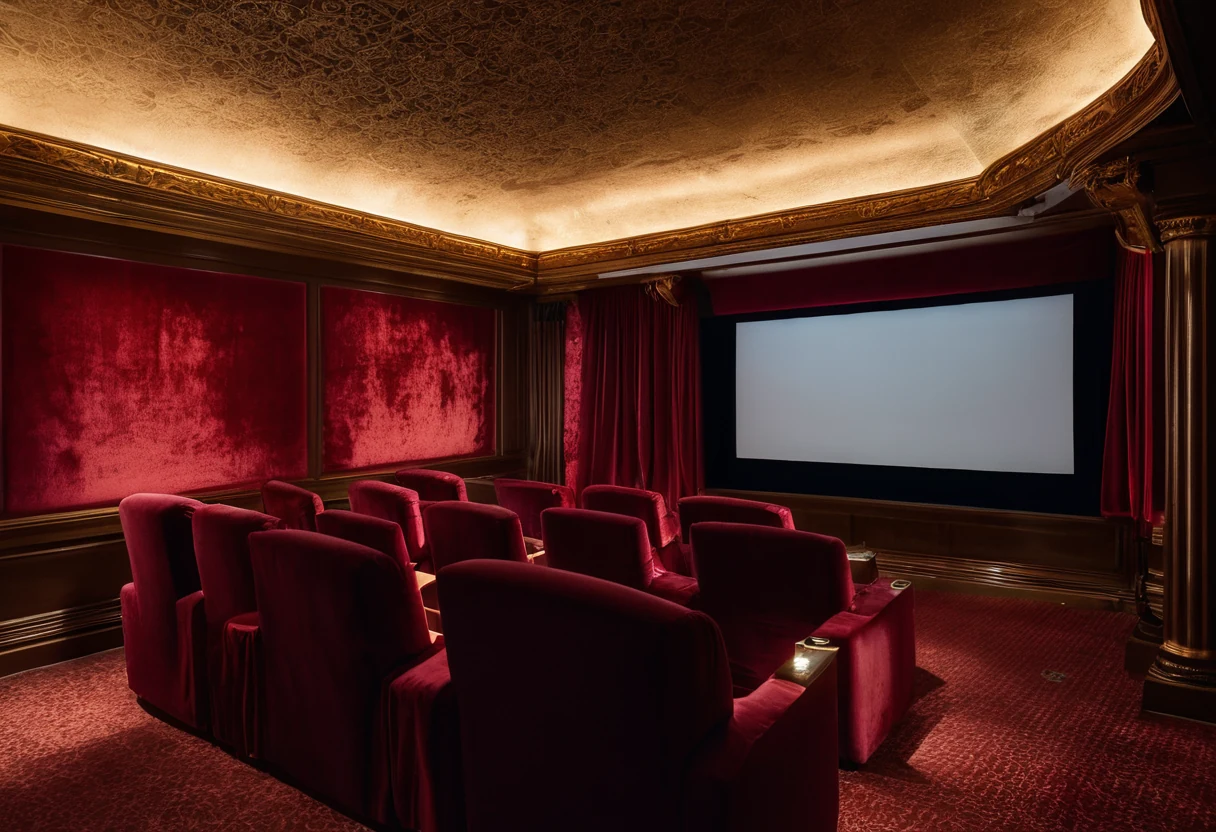
Six Acoustic Devices That Pass as Decor
| What the guest sees | What the physics is doing |
|---|---|
| Heavy velvet drapery at 2:1 fullness | Mid/high absorption, α ≈ 0.5-0.75 above 500 Hz |
| Velvet-wrapped wall panels in walnut frames | Broadband first-reflection absorbers, NRC 0.8-1.0 |
| Carved ribs, coffers and relief panels | Diffusion: scattering reflections to keep the room alive |
| Fretwork or perforated wood screens | Tuned Helmholtz absorption for problem frequencies |
| Classical corner columns and pilasters | Bass traps at the room’s pressure maxima |
| Deep carpet on resilient underlay | Floor-bounce control and footfall silence |
The summary the trade gives clients fits in one sentence: in a great cinema nothing is only beautiful. Velvet sounds better because velvet, measured and placed by someone who ran the numbers, literally is the sound system’s final component.